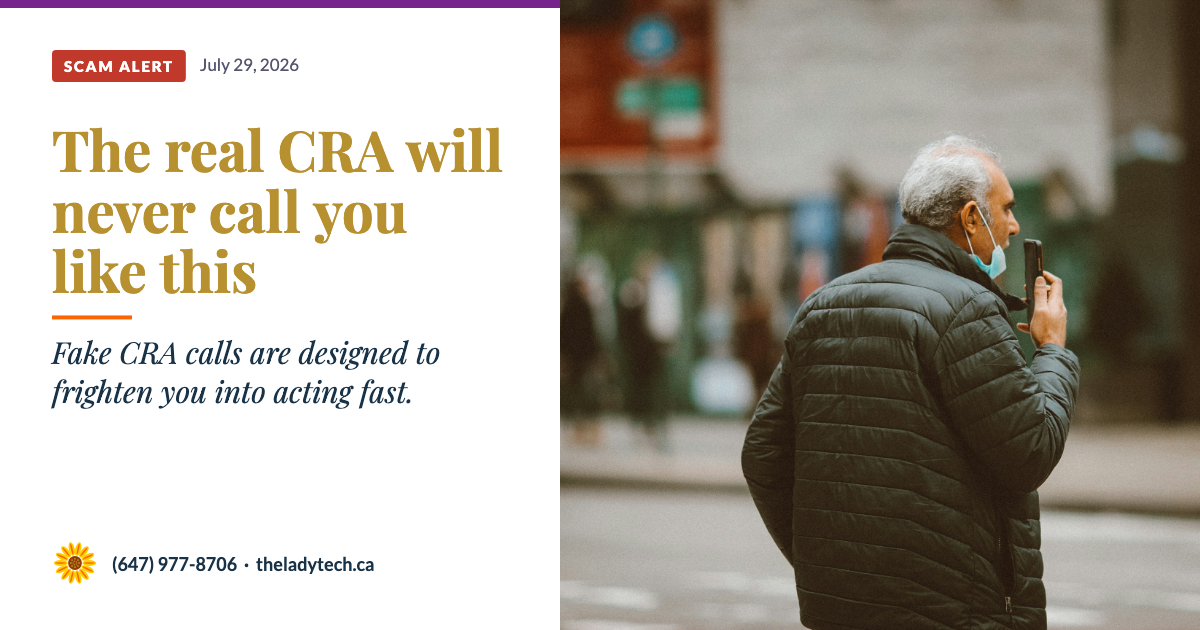
Your phone rings, or you come home to a voicemail. The message says it's the CRA — the Canada Revenue Agency — and that you owe money. There's a case number. There's a warning. If you don't call back immediately, you could be arrested, deported, or taken to court. The callback number is right there in the message.
These calls can feel alarming even if you immediately suspect something is wrong. They're designed to. They reach people who may genuinely be uncertain about their tax situation, who don't know exactly what a legitimate CRA call sounds like, or who simply panic when they hear the word "arrest."
Here's what you need to know: the CRA does not call people and threaten arrest. A call that does this is not from the CRA — no matter what the call display says.
What the Real CRA Will Never Do
The best way to recognize a fake CRA call is to know, in advance, exactly what the real CRA never does. This list doesn't change.
- Demand immediate payment over the phone
- Threaten arrest, deportation, or legal action if you don't pay right now
- Ask you to pay with gift cards, cryptocurrency, or wire transfer
- Tell you to stay on the line while you drive to a store to buy gift cards
- Send police to your door to collect a payment — police act independently and do not collect debts on behalf of the government
- Ask for your banking information or credit card number on an unsolicited call
- Ask for your SIN, passport number, or date of birth during a call you did not initiate
- Tell you to keep the call secret from family members
⚠ Important
If someone on the phone does any of these things, hang up. The real CRA sends written notices to your mailing address before calling about any amount owing. If you owe money, you will receive a letter first.
What the Scam Sounds Like
The calls vary, but the script follows a recognizable pattern:
⚠ Watch for this pattern
The setup: A voicemail — often automated — warns that a legal file has been opened in your name for unpaid taxes, or that a warrant has been issued for your arrest. There is a case number and a callback number.
The pressure: If you call back, someone answers — sometimes calm and official-sounding, sometimes confrontational. They confirm the amount you "owe" and insist it must be paid today to stop legal action or arrest.
The payment method: Gift cards are the most common demand — specifically Apple Gift Cards or Google Play cards. They'll ask for the card numbers over the phone once you've purchased them. Some scammers direct people to Bitcoin ATMs instead.
The isolation: They may tell you not to tell anyone — including family members or your bank — claiming it is a confidential legal matter that will only be made worse if you involve others.
The fake caller ID: Your phone shows a number that appears to be from Ottawa, or even the real CRA's phone number. This is call display spoofing — the number you see is fake and cannot be trusted.
If you pay once, the calls often continue. Scammers keep records of who complied and will contact you again — sometimes posing as a different agency offering to help you recover the money you lost.
Why It Works — And Why That Is Not Your Fault
The CRA represents real authority. Most people don't know exactly what they owe at any given moment, or precisely what a legitimate CRA call sounds like — and that uncertainty is what scammers exploit. A case number, a professional-sounding voice, and the word "warrant" are enough to make many people hesitate before hanging up.
Fear of legal trouble — especially anything involving arrest — can override the part of your thinking that would otherwise say: stop and check. The threat of police action is specifically designed to trigger that response. It has nothing to do with how careful or intelligent you normally are.
According to the Canadian Anti-Fraud Centre, government impersonation fraud — the category that includes fake CRA calls — has been among the most commonly reported scam types in Canada for years. It is deliberately engineered to work on careful people.
What To Do When You Get a Call Like This
Hang up — or don't call back
You don't owe anyone on an unsolicited call an explanation, and you don't need to be polite about ending it. If the call is threatening or demanding immediate payment, hang up. If it's a voicemail, do not call the number left in the message.
Call the real CRA directly if you're concerned
If you want to check whether you actually have an outstanding balance, call the CRA's official individual inquiries line directly at 1-800-959-8281. That number is from the CRA's website at canada.ca — not from any voicemail. You can also log in to My CRA Account at canada.ca/cra-my-account to see your balance yourself.
Do not buy gift cards
No government agency in Canada will ever ask you to settle a debt using gift cards. Once the card numbers are given over the phone, the money is gone and cannot be traced or recovered. If you're at a store and someone on the phone is telling you to buy gift cards to pay a tax debt, hang up before you reach the register.
Tell someone
If you received a call like this, tell a family member or someone you trust. Scammers try to create shame and secrecy around these situations — it helps them. Talking about it means the next call doesn't catch you off guard, and it protects the people around you too.
If You Already Paid or Gave Out Information
Please don't be embarrassed. These calls succeed on careful, capable people every day. The script is professionally designed to override normal judgment.
- If you paid with gift cards, keep the cards and the receipts and contact the retailer immediately. Recovery is not guaranteed, but some retailers can freeze a card's remaining balance if you act quickly.
- If you paid by e-transfer or wire transfer, call your bank right away. Some transfers can be recalled, but time is critical.
- If you gave out your SIN or banking details, contact your bank and consider placing a fraud alert with Equifax (1-800-465-7166) and TransUnion (1-800-663-9980).
- Report it to the Canadian Anti-Fraud Centre at 1-888-495-8501 or online at antifraudcentre-centreantifraude.ca. Your report helps the CAFC track call patterns and warn other Canadians.
- Contact local police if significant money was lost.
✓ How to verify a call you're unsure about
If you receive a call from someone claiming to be the CRA and you're not sure whether it's legitimate, hang up and call 1-800-959-8281 — the real CRA's individual inquiries line. A real agent can tell you whether anything in your file requires attention. Never call back a number left in a voicemail without verifying it independently first.
⚠ Disclaimer
This article is for general information and awareness only and does not constitute legal, financial, or tax advice. Scam tactics evolve constantly — information here was current as of July 29, 2026 but may not reflect the latest methods. The Lady Tech assumes no liability for losses resulting from fraud or cybercrime. Always contact your bank, local police, or the Canadian Anti-Fraud Centre (1-888-495-8501) if you believe you have been targeted.